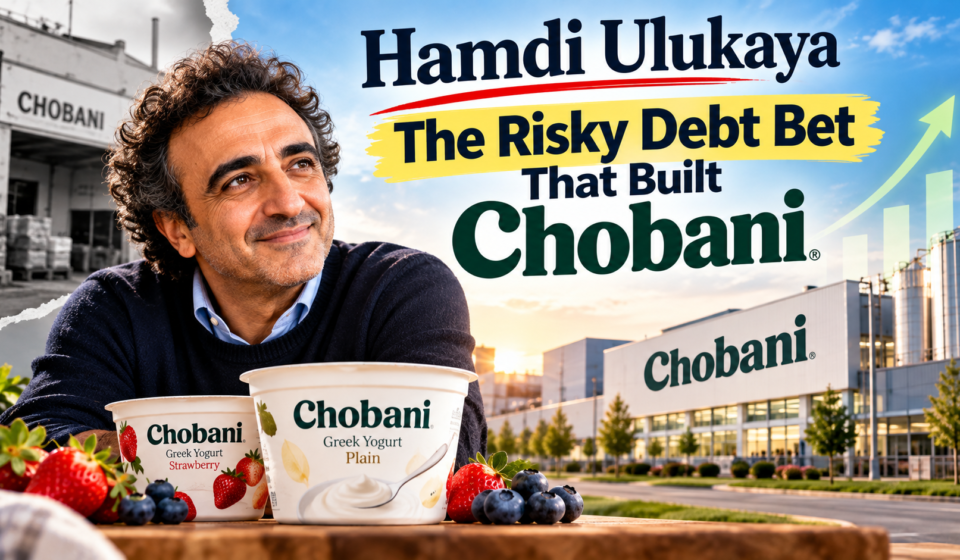
Chobani is now one of the largest yogurt brands in the US. It started with a closed factory, a bank loan and a founder who had never made yogurt for sale. This article covers what happened and what it teaches about buying distressed assets, taking on debt, and winning on quality. It also covers the risks, because Chobani’s story had some rough years too.
The Short Version
- Hamdi Ulukaya, who moved to the US in 1994, ran a small feta cheese business in upstate New York.
- In 2005 he heard that Kraft was closing a yogurt plant in South Edmeston, New York.
- He bought it with a loan guaranteed in part by the US Small Business Administration (SBA). In a later interview he said the plant cost $700,000, with about $300,000 more for other costs, so roughly $1 million in all.
- He hired some of the plant’s former workers, spent about two years developing a recipe, and launched the brand in 2007.
- By 2009, major grocery chains and warehouse clubs were carrying it. Chobani became the top-selling yogurt in the US, and the SBA named it its 2012 Entrepreneurial Success of the Year.
- In 2014 the company took a $750 million financing deal from the investment firm TPG after setbacks at its large Idaho plant.
- In October 2025, Chobani raised $650 million in equity at a reported $20 billion valuation. Bloomberg reports revenue of $3.8 billion for the twelve months ending December 27, 2025.
Lesson 1: Distressed Assets Can Be Bargains, But Do the Homework
A distressed asset is something being sold cheaply because the owner is in trouble or leaving the business. Here it was a factory that Kraft no longer wanted.
According to Ulukaya’s own account, the plant looked rundown and he doubted it was worth the price at first. What changed his mind was talking to the people who knew it. He asked the plant manager which people he would need to hire to bring it back to life. About 55 employees were losing their jobs when Kraft closed it, according to a local business report. Several accounts say he hired a few of them.
What to check before buying a distressed asset:
| Question | Why it matters |
|---|---|
| Why is it being sold? | A bad location or weak demand is a warning sign. |
| What is the true cost to get it working again? | Repairs, equipment and permits can exceed the price. |
| Who knows how it runs? | Experienced people reduce risk. |
| Is there real demand for what it makes? | A cheap factory is useless without customers. |
| Can I survive if the first year is slow? | Turnarounds usually take longer than planned. |
The takeaway: A low price is only part of the cost. Ulukaya also had a clear product idea and a market he understood, which gave the factory a purpose.
Lesson 2: Understand What an SBA-Backed Loan Actually Is
Many articles say Ulukaya “got an SBA loan.” The SBA does not usually lend the money itself. According to SBA’s materials, in its 7(a) program the SBA guarantees loans made by private lenders such as banks. If the borrower defaults, the lender can ask the SBA to buy the guaranteed portion. The SBA, in its own description, reduces risk to lenders so that they can offer financing that might not otherwise be available on reasonable terms.
In Chobani’s case, a bank (KeyBank, according to an SBA award announcement) made the loan, and Ulukaya said in an interview that the SBA guaranteed about half of it.
Important details for today’s borrowers (rules have changed since 2005, so check the SBA’s current terms):
- The SBA guarantee protects the lender, not you. You still owe the money.
- Many small business loans require collateral and a personal guarantee from owners, which means your personal assets can be at risk. Lender-reported guidance says owners of 20% or more of the business generally must provide one.
- Fees and interest rates apply. The SBA sets maximums, but the lender negotiates the actual terms.
Lesson 3: “Calculated” Debt Means You Know the Downside
Debt can speed up growth, but it also creates fixed payments that are due even in a slow month. Before borrowing, ask:
- Can the business make the payment in a bad month? Test with low sales, not hopeful sales.
- What happens if it fails? Know what is pledged as collateral.
- What is the total cost? Look at interest, fees and the repayment schedule.
- Is the debt buying something that produces income? A machine that makes products is different from covering everyday expenses.
- Do I have a backup plan? Savings, a second income or a smaller version of the plan.
Chobani’s later financing shows what can go wrong. In 2012 the company built what was described as the world’s largest yogurt plant in Twin Falls, Idaho. The plant reportedly cost about $450 million to build and ran into issues with public health officials, according to the Christian Science Monitor. Two years later, in 2014, Chobani took the $750 million TPG deal. News reports described it as a financing that came with warrants, meaning TPG could buy part of the company, reportedly 20% or more. They also reported tension between Ulukaya and TPG over the company’s direction.
In 2016, Ulukaya announced that he would give employees shares worth up to 10% of the company, payable if it is sold or goes public. That also reduced the share TPG could receive. TPG later left the shareholder list, and a Canadian pension fund became a minority investor.
The lesson: Large borrowing can fund growth, but expensive financing can cost control. Read the terms, including any equity-like features, before you sign.
Canva & Melanie Perkins: From Rejection to Unicorn
How Gymshark Turned a Garage Startup Into a Cult Brand
Lesson 4: Win Through Product Quality
Chobani did not win with the cheapest price. The company was one of the main brands that popularized thick, strained Greek yogurt in the US, which has more protein than traditional yogurt. Ulukaya hired a yogurt expert from Turkey and tested many recipes before launch.
The results show up in the sales numbers. Chobani reportedly sold 200,000 cases a week by mid-2009. A research firm cited by Bloomberg says sales rose almost 400 percent from 2009 through 2012.
How a small business can use this idea:
- Pick one product and make it clearly better than what is on offer, not just a little different.
- Test with real customers before you scale. Ask what they notice and what they would pay.
- Do not rush. Several accounts say the recipe took about two years to perfect.
- Make quality easy to see, in taste, texture, ingredients or results.
A caution: quality alone is not enough. Chobani also needed shelf space and distribution, and early support from grocery chains and warehouse clubs helped it reach customers.
Where Chobani Is Now
The company has expanded into oat milk, creamers and coffee. It bought La Colombe for a reported $900 million in 2023 and Daily Harvest in 2025. It also announced a $1.2 billion plant in Rome, New York, and a $500 million expansion in Idaho. A 2026 bond offering prospectus cited by Bloomberg indicates that Ulukaya owns just under 90% of the company.
Chobani is private, so these figures come from company statements, bond documents and press reports, not audited public filings.
What This Story Does Not Prove
- It is not a template. A closed plant, a founder with dairy experience and a growing taste for Greek yogurt came together at a particular time.
- Survivorship bias. Many people who buy troubled assets or borrow heavily do not succeed.
- Debt was risky. Chobani had setbacks in Idaho and needed rescue-style financing. Success was not smooth.
- Details vary by source. Accounts differ on how many former Kraft workers were hired and on the exact loan size. I used the points that appear in more than one place.
- Today’s rules differ. SBA loan terms, fees and eligibility have changed since 2005.
Simple Worksheet: Evaluate a Distressed Asset or a Loan
Part A: The asset
- What am I buying, and why is it for sale? ___
- Purchase price: $___ | Estimated cost to fix or restart: $___ | Total: $___
- Who can tell me how it really works? (Interview at least 2 people.) ___
- Who are my first 10 customers, and what would they pay? ___
Part B: The loan
5. Loan amount: $___ | Interest rate: % | Term: ___ years | Monthly payment: $
6. Collateral and personal guarantee required: ___
7. Monthly cash I expect in a bad month: $___ (Is it more than the payment plus other costs?)
8. Months of payments I could cover from savings: ___
9. Is any part of the deal equity-like (warrants, profit share, board rights)? ___
10. Who will I ask to review the terms (attorney, accountant, SBA resource partner)? ___
Part C: Quality
11. What will make my product clearly better? ___
12. How will I test it with 20 real customers before scaling? ___
Key Takeaways
- A distressed asset is only a bargain if you can restart it and customers want what it makes.
- An SBA-backed loan protects the lender, so you still owe the money and may carry personal risk.
- Calculated debt means testing a bad month, not just a good one.
- Expensive financing can cost you control as well as money.
- Product quality can open doors, but you still need distribution and cash to survive growth.
Sources and Further Reading
- U.S. Small Business Administration, 7(a) loan program information and loan terms
- Central New York Business Journal, Chobani wins SBA’s 2012 Entrepreneurial Success of the Year Award
- Central New York Business Journal, Chobani’s $1.2 billion Rome plant
- Summit, People Over Profits: A Guide to Mission-Driven Business with Chobani Founder Hamdi Ulukaya (interview transcript)
- Christian Science Monitor, Chobani workers’ surprise bonus: a stake in the company
- Boston.com, A windfall for Chobani employees
- Just Food, Chobani gets new minority investor
- Reuters via The Dairy Site, Chobani raises $650M to fund US plant expansion
- Bloomberg Billionaires Index, Hamdi Ulukaya
- Wikipedia, Chobani (used only for details that other sources repeat)
Disclaimer: This article is for general education and is not financial or legal advice. Please speak to a licensed professional about your own situation before borrowing or buying a business.


[…] How 1 Risky Loan Built Chobani’s Empire […]