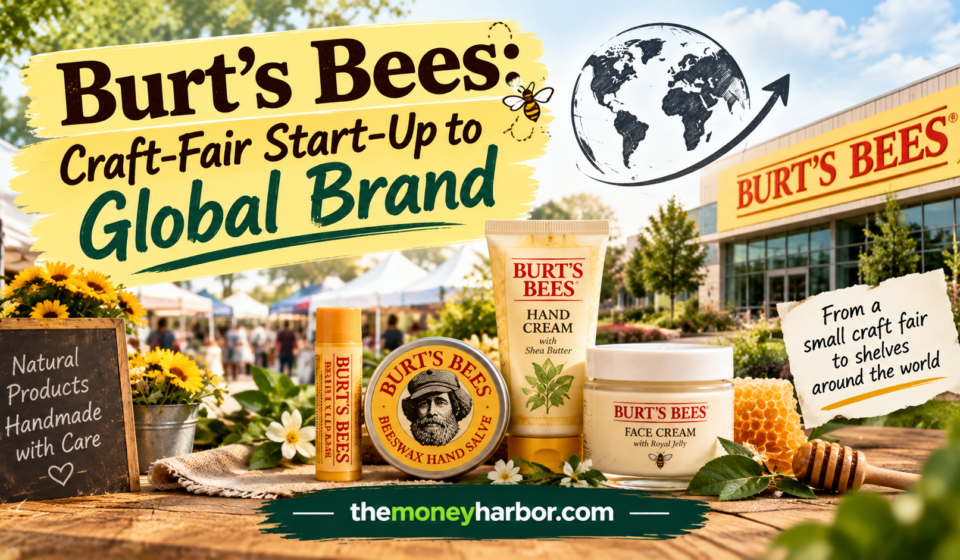
Burt’s Bees is now a global personal care brand owned by Clorox. It began with a leftover material, a craft fair table and very little money. This article looks at what the story teaches about starting small, using what you already have, keeping your branding simple and protecting yourself in a partnership.
A Quick Correction to the Common Story
The story is often told as “a beekeeper’s honey side hustle became a skincare empire.” The details are a little different:
- Burt Shavitz was a beekeeper with a roadside honey stand in Maine.
- Roxanne Quimby, an artist, started making candles from his unused beeswax. The business grew from there.
- The product that made the brand famous, beeswax lip balm, came later.
So the first product was a by-product, not the honey itself.
The Short Version
- 1984: According to the company, Quimby made candles from Shavitz’s leftover wax. They made $200 at their first craft fair, and within a year about $20,000.
- 1989: Orders began to grow. By then the business was shipping hundreds of candles, according to the company.
- 1991: The company incorporated and added lip balm, which became its best-selling product, according to company histories.
- 1993-94: The company moved to North Carolina. Business histories say it had trouble finding skilled workers in rural Maine, and North Carolina lobbied hard to attract it. It settled in a former garment factory in Creedmoor, near Raleigh.
- Late 1990s: The partnership between Shavitz and Quimby fell apart, and Quimby bought out Shavitz.
- 2007: Clorox bought Burt’s Bees for a reported $925 million.
Lesson 1: Start With What You Already Have
Quimby did not begin with a big budget. She used a waste product, leftover beeswax, and sold simple products at craft fairs. NPR’s account of her story describes her living in a cabin in Maine with a simple lifestyle, and a first sale of $200 was a big deal for her.
Using what you already have lowers your risk. Ask yourself:
- What skill, material or by-product do I already have?
- Can I make a small batch and test it?
- Where can I sell face to face, such as a craft fair, a farmers’ market or a local shop?
Lesson 2: Face-to-Face Selling Is Cheap Market Research
A craft fair table costs little, and you hear honest feedback right away. People pick things up, ask questions and tell you what they would pay. Burt’s Bees began this way, and one account says it first sold items at craft fairs throughout Maine.
Try this: At your first test sale, write down every question customers ask. Those questions often show you what to put on your label and what to say.
Lesson 3: Keep Branding and Packaging Simple
Burt’s Bees became recognizable through a few consistent choices. Shavitz’s bearded face appears as a woodcut-style logo, and the brand’s color is yellow, a favorite of Shavitz, according to press reports. One regional account says early containers were beehive-shaped with handmade labels, though I could not verify that detail.
The business lesson is that simple, consistent packaging is easy to recognize and cheap to reproduce. You do not need a large design budget. You need:
- One clear name and look.
- A short story that customers can repeat (for example, “made from beeswax”).
- Labels that are easy to read, including what the product is and what it is for.
- Consistency, so a customer can spot your product again.
Lesson 4: Grow in Steps, Not All at Once
The business moved from candles to a wider range of products, then to a factory and larger distribution. One company history says that after the North Carolina move the business began adding automation “one piece of machinery at a time” and cut many handmade items. That is a sensible pattern: do it by hand until demand is proven, then invest in equipment.
Reports also say the company opened a New York showroom in 1999, and that a seasonal deal to sell lip balm in Starbucks stores followed. These details come from a business-history site, so treat them as reported.
Reports of the company’s revenue growth are inconsistent. Some online accounts say sales reached $20 million around 2000 and $60 million in 2001. I could not verify these figures in a primary source, so I do not rely on them.
Lesson 5: Be Careful What You Call “Natural” or “Organic”
Burt’s Bees is known for natural ingredients. If you sell personal care products in the US, the wording on your label matters.
According to the FDA:
- It has not defined the term “natural” for cosmetic labeling.
- It also has no regulations for the term “organic” for cosmetics.
- The USDA regulates “organic” for agricultural products under its National Organic Program. A cosmetic with an organic claim must follow both USDA rules for the claim and FDA rules for labeling and safety.
- Choosing ingredients you consider natural or organic is not a guarantee that a product is safe.
- Some “personal care products” are regulated differently. For example, some are regulated as drugs or devices, and some soaps by the Consumer Product Safety Commission.
- The FDA says that the Modernization of Cosmetics Regulation Act (MoCRA) exempts certain small businesses from facility registration and product listing. Those exemptions have conditions, so check the FDA’s current page.
The takeaway: Make claims you can back up, and check the rules before printing them.
Also read:
Canva & Melanie Perkins: From Rejection to Unicorn
How Gymshark Turned a Garage Startup Into a Cult Brand
How 1 Risky Loan Built Chobani’s Empire
Lesson 6: Put Partner Agreements in Writing
This is the hard part of the story. Shavitz’s name and face are on the brand, but the partnership between him and Quimby broke down in the 1990s. Accounts say Quimby bought out his stake. Wikipedia reports the price as $170,000. The New York Times, as quoted by Entrepreneur, estimated that his original stake would have been worth about $59 million at the 2007 sale. The same coverage says Quimby gave him about $4 million after the sale, and he was paid an undisclosed amount to serve as a brand ambassador.
These figures come from secondary sources and were disputed, and the two later differed on how they described events. I’m not judging either person. The lesson is practical: a business and a personal relationship can be a risky mix.
If you start a business with a friend, partner or family member:
- Write down who owns what percentage.
- Agree on roles, pay and decision-making.
- Agree what happens if one person leaves, and how the shares will be valued.
- Have an attorney review the agreement.
What This Story Does Not Prove
- Survivorship bias. We hear about Burt’s Bees because it succeeded. Many craft-fair businesses stay small.
- Timing helped. Interest in natural products grew over these decades.
- It was not purely bootstrapped. One secondary source says Quimby sold 80% of the company to a private equity firm, AEA Investors, in 2004 for $173 million before Clorox bought it. I could not verify this in a primary source. If true, the company grew for about 20 years before taking outside investors, but it did eventually take them.
- Sources disagree. Reported sale prices range from $913 million to $970 million. I used the most common figure, about $925 million, and labeled it as reported.
Simple Worksheet: Start Small and Sell Smart
- What do I already have (skill, material, by-product, space)? ___
- First product idea (one product): ___
- Smallest test: (a craft fair table, a local market, a few shops) Where and when? ___
- Cost to make 20 units: $___ | Price per unit: $___ | Profit per unit: $___
- My brand in one line and one color or symbol: ___
- Label check: What claims will I make? Can I support each one? ___
- Rules check: Are my products regulated as cosmetics, drugs or something else? What do the FDA and my state require? ___
- Customer questions I heard (write after the test): ___
- When will I invest in equipment, and what result tells me it is time? ___
- If I have a partner: Who owns what, what are our roles, and what happens if one of us leaves? Have we put it in writing? ___
Key Takeaways
- Start with what you already have and test in person.
- A simple, consistent look is cheap and memorable.
- Add equipment and staff after demand is proven.
- Check your label claims. “Natural” and “organic” are not interchangeable.
- Put partnership terms in writing before the business grows.
Sources and Further Reading
- FDA, Small Businesses & Homemade Cosmetics: Fact Sheet
- FDA, “Organic” Cosmetics
- NPR, Burt Shavitz, namesake and co-founder of Burt’s Bees, dies (quotes the company’s history page)
- NPR, How I Built This: Burt’s Bees, Roxanne Quimby
- Entrepreneur, Burt Shavitz, the bearded hippie co-founder and face of Burt’s Bees, dies at 80 (cites the New York Times)
- FundingUniverse, Burt’s Bees, Inc. history
- Wikipedia, Burt’s Bees and Roxanne Quimby (used only for points other sources repeat)
- U.S. Small Business Administration, Business Guide
Disclaimer: This article is for general education. Please speak to a licensed attorney, accountant or regulatory adviser about your own situation, especially for product claims and partnership agreements.