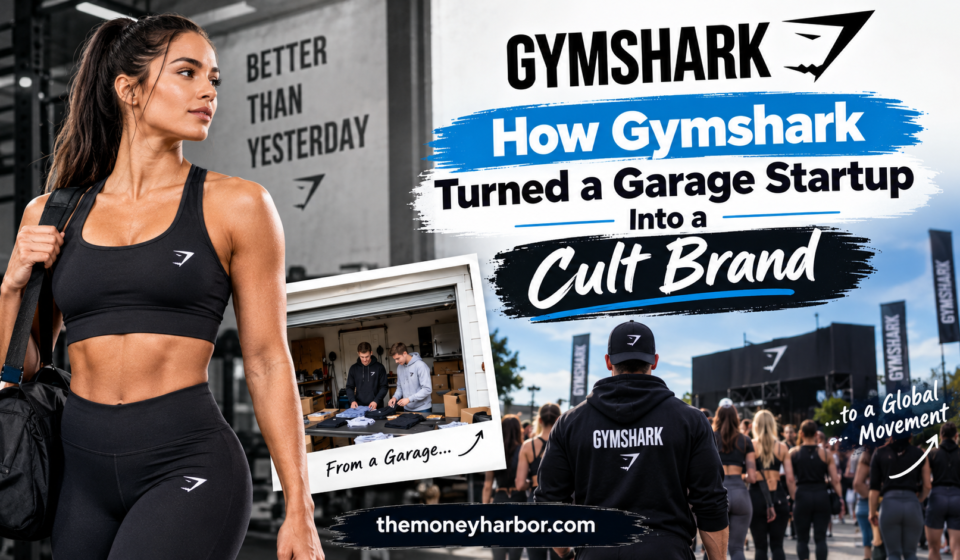
Gymshark is one of the best-known fitness clothing brands in the world, but it started with a university student, a part-time job and a garage. It is a useful story for anyone trying to build a brand without a big advertising budget. It also has limits, and I’ll point those out too.
How Gymshark Started
Ben Francis was a student at Aston University in Birmingham, England, delivering pizzas for Pizza Hut at night. In 2012, at age 19, he launched Gymshark with his school friend Lewis Morgan.
The first product was not clothing. Forbes reports that the pair started by selling supplements online, buying in bulk and reselling at a small profit. They then put their small profits into a screen printer and a sewing machine, and began making fitness clothing in his parents’ garage. Francis has said he started because the bodybuilding clothing he wanted was not available in the UK.
One often-repeated detail is that the machines cost about £1,000 of savings. I found that figure in Wikipedia’s summary of other sources, not in Forbes or CNBC, so treat it as reported, not confirmed.
Lesson 1: Start by Solving a Problem You Have Yourself
Francis was a gym-goer who could not find the clothes he wanted. He was his own first customer. That gave him a clear idea of who the product was for and what they cared about.
Try this: Write down one product you wish existed. Then ask five people who are like you whether they want it too.
Lesson 2: Use Early Profits to Fund the Next Step
Gymshark did not start with a big loan or investor. The founders reinvested what the supplement site earned into equipment to make a new product. That kept their risk low.
The approach has a trade-off. Self-funding makes you move carefully and slowly. According to one account, the first supplement sale took around six weeks, so the beginning was not easy.
Lesson 3: Give Real Fans a Reason to Talk About You
The turning point in most Gymshark stories is a fitness event in Birmingham. CNBC reports that around ten minutes into the event, Francis and Morgan decided to give popular fitness YouTubers free products. Some of those influencers wore the clothes on their channels. Forbes, as quoted by CNBC, says daily sales then rose from about $450 to $45,000.
Why did this work? It is a good example of social proof, which means people tend to trust what others like them are using. A gym-goer is more likely to try a brand worn by someone they already follow than one that just pays for an ad.
Here are the lessons that small brands can use:
- Look for people who already have a trusted audience in your niche.
- Start with products, not large payments.
- Pick people who actually fit your brand, not just the biggest names.
- Be ready for the extra demand if it works.
I’ll be honest that luck and timing also mattered. Influencer marketing was newer in the early 2010s, so there was less competition for attention. It is much more crowded now.
Lesson 4: Build a Community, Not Just an Ad Campaign
CNBC reported in 2021 that Gymshark was an early adopter of influencer marketing, partnering with well-known fitness YouTubers and building a community of its own ambassadors, known as “Gymshark athletes.” The brand also sold only online and only through its own website at that time, which gave it direct contact with customers.
A small business can borrow the idea:
- Reply to comments and messages yourself.
- Feature customer photos (with permission).
- Host a small meetup, class or online challenge.
- Ask customers what to make next.
A community takes time. It is not a quick trick.
Lesson 5: Keep Your Social Proof Honest (and Legal)
This is the part many success stories skip. If you use influencers or reviews in the US, there are rules.
Influencer disclosure. The FTC says that if you endorse a product through social media, your message should make it obvious when you have a “material connection” with the brand. That includes being paid or being given free or discounted products. The FTC also says to make a disclosure when a brand gives you free products and you then mention one, even if you weren’t asked to. Disclosure should be placed with the endorsement itself.
Fake reviews and followers. The FTC finalized a rule in August 2024, effective October 2024, banning fake or false reviews and testimonials, including AI-generated ones. It also bans buying reviews that express a particular sentiment, and buying or selling fake social media followers or views for commercial purposes when the buyer knew or should have known the numbers were fake.
The simple rule I would follow is: real customers, real reviews, clear disclosure. Anything that tries to fake popularity is a risk. Gymshark is a UK company, so UK advertising rules apply to it. If you sell to US customers, check the FTC’s guidance and talk to a qualified adviser.
Lesson 6: Funding Choices Come With Trade-Offs
In 2020, Gymshark sold a 21% stake to the private equity firm General Atlantic for $300 million, valuing the company at about $1.45 billion, according to Forbes. Francis reportedly kept around 70% of the business. For years before that, the company grew largely on its own earnings.
Selling a stake can provide money for expansion, and it also means sharing ownership. In July 2026, the Financial Times reported that Francis was in talks to buy back some of that stake. The reasons have not been confirmed by the company, so I won’t guess at them here.
Compare the main ways to fund a small brand:
| Path | Upside | Trade-off |
|---|---|---|
| Reinvest profits | Keep full ownership | Slower growth |
| Personal savings | Fast and simple | Your own money is at risk |
| Loan | Keep ownership | Repayments are due even in a slow month |
| Investors | Fast growth capital | You share ownership and some control |
The SBA Business Guide has a section on funding options if you want to compare choices.
The Story of Mailchimp: From Agency to SaaS
Madam C.J. Walker: Building a Business on Customer Needs
What Sara Blakely and Spanx Can Teach You on Starting Small
The Reality Check: Growth Gets Harder
A garage-to-billions story can make growth sound smooth. Gymshark’s latest published numbers show a more grown-up picture. For the year to July 2025, revenue rose 6.4% to £646 million, and pre-tax profit fell to about £7 million from about £11.8 million, according to Companies House filings reported by trade press. Gymshark said the lower profit was intentional and tied to opening new stores and holding free events.
The company that once sold only online is now opening stores. That is a useful reminder: what works at one stage may not work forever, and big brands still face costs and trade-offs.
What This Story Does Not Prove
- It is not a guarantee. Many small brands try influencer gifting and get little result.
- Survivorship bias. We hear about Gymshark because it succeeded.
- The “multi-million” label is too small. Gymshark reports hundreds of millions in revenue now. I kept the early story modest, but the end result was exceptional.
- Some details vary. Sources differ on small points, so I used details that appear in the main reporting.
Simple Worksheet: Plan Your Low-Budget Community Marketing
- My customer: Who is it for? (Be specific.) ___
- Where they spend time online: ___
- Trusted voices in my niche (5 names): ___
- Smallest gift or sample I could send: ___
- What a “good fit” partner looks like: ___
- Disclosure plan: How will partners clearly show they received a free product or payment? ___
- Real social proof I can collect: (customer photos, honest reviews, testimonials, with permission) ___
- Community action this month: (reply to comments, host a challenge, ask for feedback) ___
- Budget I can afford to lose: $___
- Measure: What will I count after 30 days? (Sales, sign-ups, replies.) ___
- Funding plan: What will pay for growth, and what trade-offs am I willing to accept? ___
Key Takeaways
- Start with a problem you understand and a customer you can talk to.
- Reinvest early profits to keep risk low.
- Social proof works best when it is real and clearly disclosed.
- Community takes steady effort, not a one-off campaign.
- Choose funding on purpose. Control, speed and risk all trade off.
- Even great brands face slower growth, so plan for the next stage.
Sources and Further Reading
- CNBC Make It, 30-year-old started his business with a website, sewing kit and Pizza Hut salary (draws on Forbes)
- Forbes Australia, From bodybuilder to billionaire: How Gymshark founder Ben Francis built a sportswear unicorn
- CNBC, Gymshark founder Ben Francis: We don’t worry about larger brands
- Retail Week, Gymshark founder in talks to buy back stake sold to private equity firm
- SGI Europe, Gymshark founder in talks to buy back stake from General Atlantic (Companies House figures)
- FTC, Disclosures 101 for Social Media Influencers
- FTC final rule on fake reviews and testimonials, as summarized by Maynard Nexsen and Manatt
- U.S. Small Business Administration, Business Guide
Disclaimer: This article is for general education. Please speak to a licensed financial professional, attorney or advertising-law adviser about your own situation.



[…] How Gymshark Turned a Garage Startup Into a Cult Brand […]
[…] How Gymshark Turned a Garage Startup Into a Cult Brand […]
[…] How Gymshark Turned a Garage Startup Into a Cult Brand […]