By Mark Collins. I’m a finance enthusiast. This article is for education only and is not financial, legal or tax advice.
When people talk about Madam C. J. Walker, they often stop at one headline: “first self-made female millionaire.” Her story is more useful than that. It shows how one person built a business by serving customers others overlooked, and how she trained other people to earn their own income. It also has limits and risks worth knowing.
Who Was Madam C. J. Walker?
Walker was born Sarah Breedlove in 1867, the daughter of formerly enslaved parents. By age seven she had lost both parents, and she later worked for about 18 years as a washerwoman, sometimes earning as little as $1.50 a day.
In the 1890s she began losing hair from her scalp. She experimented with formulas and settled on a routine of washing more often and using a balm she made herself. That personal problem became the start of her business.
The Short Timeline
- Early 1900s: She worked as a sales agent for another Black hair-care entrepreneur, Annie Turnbo Malone. She then began selling her own formula door-to-door and used her married name, Walker, on her products.
- 1910: She moved to Indianapolis and built a factory, a beauty school and a salon.
- 1913: She took her products to Central America and the Caribbean.
- 1919: She died at age 51. Her personal fortune was estimated at $600,000 to $700,000, and ownership of the company added significantly to that.
The Smithsonian notes that by 1907 she was earning about $300 a month, compared with about $300 a year before.
Lesson 1: Build Around a Specific Customer Need
Walker did not try to sell to everyone. Her biographer, A’Lelia Bundles, says Walker was going after African American women and knew this market was untapped. The Smithsonian also notes that many women of the time washed their hair rarely, and that harsh products and poor conditions often made scalp problems worse.
The business lesson is simple: a narrow, well-understood customer is easier to serve than a vague “everyone.”
Try this: Finish this sentence: “My product helps [specific person] solve [specific problem] better than [what they use now].”
Lesson 2: Use Several Low-Cost Ways to Reach Customers
Walker advertised in Black newspapers across the country, accepted mail orders and awarded franchises, which extended her reach at a time when segregation made travel difficult for Black women. Her sales channels did not depend on one storefront.
Today you can test the same idea cheaply: a simple website, a local market stall, an email list or one social channel. Start with one and measure what works before adding more.
Lesson 3: Training Can Be Part of the Product
Walker did not just sell tins. Her company offered training to women, both as hair stylists and as sales representatives. A Smithsonian curator explains that this gave thousands of women jobs and careers and a chance to earn money in their own community.
A trained customer or agent can become a source of income, loyalty and word of mouth. If you sell a skill or product that needs explaining, teaching can be part of your business model.
Lesson 4: Treat Your Sales Network Like People, Not Just Numbers
In 1917 Walker held a national convention in Philadelphia. More than 200 women gathered, and she gave $500 in prizes, not only to top sellers but also to local clubs that gave the most to charity. She rewarded results and community involvement.
For a modern small business, this points to recognition, clear expectations and shared goals. People stay where they are respected.
Lesson 5: Use Wealth to Strengthen the Community
Shortly after arriving in Indianapolis, Walker gave $1,000 to the African American YMCA, which the Smithsonian says is about $26,000 in today’s dollars (as of 2019). She also supported schools and colleges. Other sources report that she gave $5,000 to the NAACP’s anti-lynching movement.
A fair reading: she did not treat money only as personal wealth. Whatever your own budget, a small, regular, planned giving habit is a smart way to put this lesson into practice.
A Caution About Direct Sales Today
Walker’s story involves a network of sales agents. Modern direct selling can be a very different thing, so please read this part carefully.
The FTC explains that a multi-level marketer generally distributes products through salespeople who are not employees, are not paid a salary, and are usually treated as independent contractors who may earn income depending on their own revenues and expenses. The FTC also warns about illegal pyramid schemes. In one case, a Bureau of Consumer Protection director said legitimate businesses make money selling products and services, not by recruiting.
In the sources I found, Walker’s agents are described as selling products and training in her method. I could not verify the exact pay terms of her agent system, so I won’t claim her model matches any modern company. Before you join any direct-selling program, check these:
- What do you pay up front, and what are the ongoing costs?
- Is the pay mainly from product sales to real customers, or from recruiting?
- Does the company publish typical earnings, not just the best ones?
- Can you return unsold inventory?
You can learn more or report a problem at the FTC’s consumer site.
What This Story Does Not Prove
- Wealth numbers are estimates. Walker herself denied reports in 1917 that she was a millionaire, saying she hoped to be. The “first millionaire” title is widely used but worth treating as a popular description, not a precise fact.
- Her circumstances were unique. She worked in an era of segregation and limited opportunity. Her path cannot be copied step by step today.
- Hard work was not the only factor. Timing, her partnership with her husband (a newspaper man and salesman), her connections and her own strong marketing all played a part.
- Some details differ between sources, such as the exact year she began selling. I used the points that agree.
Also read:
What Sara Blakely and Spanx Can Teach You on Starting Small
Simple Worksheet: Test Your Customer-Focused Idea
- My customer: Who exactly are they? (Age range, location, situation.)
- Their problem: What do they struggle with? Write it in their words.
- Current options: What do they use today, and what do they dislike about it?
- Five conversations: Talk to at least five real people. What did you learn?
- Reach: Which one low-cost channel will I test first?
- Help others: Could training or teaching be part of my offer?
- Giving plan: What small, realistic amount could I set aside regularly for a cause I care about?
- Stop point: What result tells me to change my plan?
Key Takeaways
- Start with a specific customer and a real problem.
- Test low-cost ways to reach them before you spend big.
- Training and community can be part of how a business grows.
- Be careful with direct-selling offers, and check the FTC’s guidance first.
- Treat popular success numbers as estimates, not guarantees.
Sources and Further Reading
- Smithsonian magazine, How Business Executive Madam C. J. Walker Became a Powerful Influencer of the Early 20th Century
- Smithsonian, Madam C. J. Walker Hair Product Tin (National Museum of African American History and Culture collection)
- A’Lelia Bundles, Madam C. J. Walker’s First National Convention (1917) (Bundles is Walker’s great-great-granddaughter and biographer)
- Indiana Historical Society, Madam C. J. Walker Papers finding aid
- Federal Trade Commission, Business Guidance Concerning Multi-Level Marketing
- Federal Trade Commission, AdvoCare settlement announcement
- U.S. Small Business Administration, Business Guide
Disclaimer: This article is for general education. Please speak to a licensed financial professional, attorney or tax adviser about your own situation.



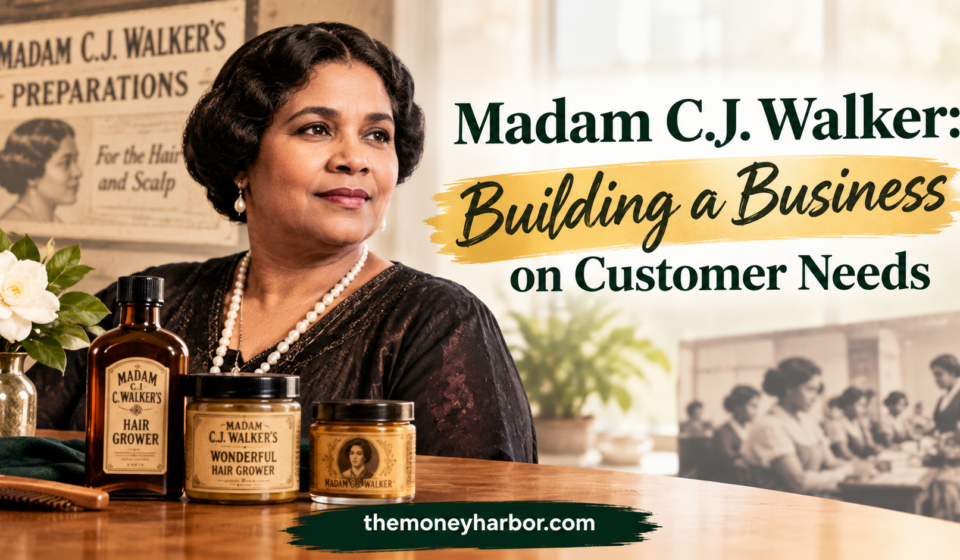
[…] Madam C.J. Walker: Building a Business on Customer Needs […]
[…] Madam C.J. Walker: Building a Business on Customer Needs […]